
Unpermitted garage conversion: what happens, and how it can be permitted (California rules)
California Contractor License #1160113, Class B (General Building)
Last updated November 9, 2026.
Quick answer
State law has a separate rule for an ADU or junior ADU built without a permit before January 1, 2020, and your building department decides how it applies to your unit. A garage turned into a bedroom, office or gym with no kitchen is not an ADU under the state definition, so ask your department what path applies. Have a converted garage that needs corrective work? Call (909) 486-3818.
This page gives the state rules, then uses the City of Los Angeles as a worked example. Other departments, including Los Angeles County, Orange County and the cities of the Inland Empire, have their own forms, checklists and processes, and they differ from the City's. Ask yours. If your lot is in the coastal zone, a coastal development permit may also be needed (section 66329).
What does state law say about a garage converted without a permit?
Government Code section 66311.7 is the state's rule for an ADU or junior ADU that was built without a permit before January 1, 2020. Subdivision (a) says: "Notwithstanding any other law, and except as otherwise provided in subdivision (b), a local agency shall not deny a permit for an unpermitted accessory dwelling unit or an unpermitted junior accessory dwelling unit that was constructed before January 1, 2020, due to either of the following:"
- "The accessory dwelling unit or junior accessory dwelling unit is in violation of building standards pursuant to Article 1 (commencing with Section 17960) of Chapter 5 of Part 1.5 of Division 13 of the Health and Safety Code."
- "The accessory dwelling unit or junior accessory dwelling unit does not comply with this article or Article 3 (commencing with Section 66333), as applicable, or any local ordinance regulating accessory dwelling units or junior accessory dwelling units."
Subdivision (b) says: "Notwithstanding subdivision (a), a local agency may deny a permit for an accessory dwelling unit or junior accessory dwelling unit subject to subdivision (a) if the local agency makes a finding that correcting the violation is necessary to comply with the standards specified in Section 17920.3 of the Health and Safety Code." Subdivision (c) says: "This section shall not apply to a building that is deemed substandard pursuant to Section 17920.3 of the Health and Safety Code."
The statute binds the agency, and the agency applies it to your unit. This page cannot tell you what your department will decide. The department decides whether your unit was built before that date, from the documents it accepts, so ask yours which ones. The City lists them in section III.C of its bulletin, named below.
Does my converted garage count as an ADU?
Section 66311.7 reaches a unit that meets the state's definition. Government Code section 66313(a) defines an ADU as "an attached or a detached residential dwelling unit that provides complete independent living facilities for one or more persons" and says it has to include "permanent provisions for living, sleeping, eating, cooking, and sanitation" on the same parcel as the home. A garage turned into a bedroom, office or gym with no kitchen does not meet that definition, so section 66311.7 does not reach it. If that describes your garage, ask your building department what path applies.
A junior ADU has its own definition in section 66313. For how the two differ, see ADU, junior ADU or room addition: which one fits my lot.
A unit built on or after January 1, 2020 goes through the ordinary ADU permit process. For those rules, see can I convert my garage into an ADU.
What can I do before I apply?
Section 66311.7(d) tells each local agency to inform the public about the section through permit checklists and its website, and to include two things. The first is "A checklist of the conditions specified in Section 17920.3 of the Health and Safety Code that would deem a building substandard." The second is telling homeowners "that, before submitting an application for a permit, the homeowner may obtain a confidential third-party code inspection from a licensed contractor to determine the unit's existing condition or potential scope of building improvements before submitting an application for a permit."
Ask your department for its checklist and its process. The City of Los Angeles describes its process in Information Bulletin P/BC 2026-161, "Streamlined Permitting of Unpermitted Dwelling Unit as ADU/JADU Under AB 2533" (effective July 15, 2026, revised September 2, 2026). It says third-party inspections "are for the homeowner's information only" and "do not resolve or exempt the homeowner from the required permit(s) and inspection(s)."
What does the building department's inspection involve?
Section 66311.7(f) says: "Subject to subdivision (c), upon receiving an application to permit a previously unpermitted accessory dwelling unit or junior accessory dwelling unit constructed before January 1, 2020, an inspector from the local agency may inspect the unit for compliance with health and safety standards and provide recommendations to comply with health and safety standards necessary to obtain a permit. If the inspector finds noncompliance with health and safety standards, the local agency shall not penalize an applicant for having the unpermitted accessory dwelling unit or junior accessory dwelling unit and shall approve necessary permits to correct noncompliance with health and safety standards."
In the City of Los Angeles, once the permit issues, the inspector uses the City's substandard checklist. Under the City's bulletin (section VI), the inspector may require covered or concealed work to be exposed. Ask your own department what its inspector will want to see.
What if the inspector finds something to correct?
The corrections come from the department, in its words and on its list. The City's bulletin says: "The permit holder is required to perform all necessary repairs or construction work to address these corrections before a final approval can be granted." Corrective work is built under the permit, after it is issued.
Any plans or engineering the department asks for come from the owner's designer, architect or licensed engineer. For what the plans and engineering involve, see who pays for plans and engineering. If a half-finished ADU is part of your situation, see finishing a half-built ADU.
What if I have received a notice to correct?
Health and Safety Code section 17980.12 applies when an enforcement agency issues a notice to correct. The delay it describes is for an owner who has received a notice to correct. Subdivision (a)(1) says: "An enforcement agency, until January 1, 2030, that issues to an owner of an accessory dwelling unit described in subparagraph (A) or (B) below, a notice to correct a violation of any provision of any building standard pursuant to this part shall include in that notice a statement that the owner of the unit has a right to request a delay in enforcement pursuant to this subdivision:"
- "The accessory dwelling unit was built before January 1, 2020."
- "The accessory dwelling unit was built on or after January 1, 2020, in a local jurisdiction that, at the time the accessory dwelling unit was built, had a noncompliant accessory dwelling unit ordinance, but the ordinance is compliant at the time the request is made."
Subdivision (a)(2) says: "The owner of an accessory dwelling unit that receives a notice to correct violations or abate nuisances as described in paragraph (1) may, in the form and manner prescribed by the enforcement agency, submit an application to the enforcement agency requesting that enforcement of the violation be delayed for five years on the basis that correcting the violation is not necessary to protect health and safety."
The agency decides. Subdivision (a)(4) says: "The enforcement agency shall grant an application described in paragraph (2) if the enforcement agency determines that correcting the violation is not necessary to protect health and safety." And subdivision (a)(5) says: "The enforcement agency shall not approve any applications pursuant to this section on or after January 1, 2030." If you have a notice, ask the agency that issued it how to submit a request.
Who decides, and where do I start?
Your building department decides, on its inspection and its records, whether and how your unit can be permitted. A builder does not decide whether a unit qualifies or passes. Start with your department. Ask which path applies to your unit, and ask for its checklist (section 66311.7(d)(1)) and its process. The City of Los Angeles example is the bulletin named above. Other departments, including Los Angeles County, have their own process. Ask yours.
Where does EMC fit?
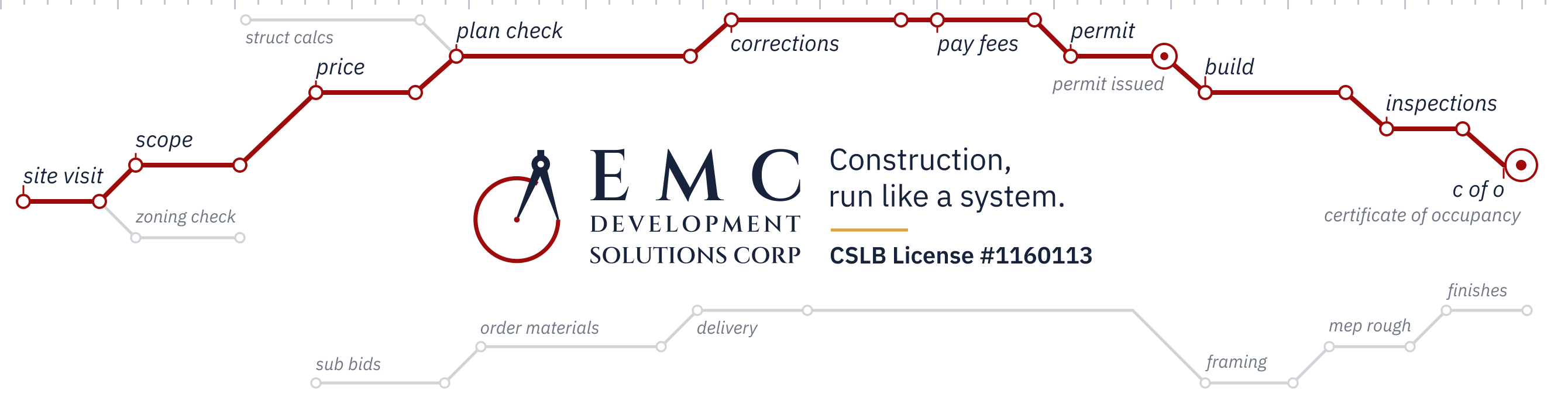
EMC Development Solutions Corp is a building contractor. Once your department has issued the permit and listed what must be corrected, we can contract to build the corrections. No corrective work starts before the permit is issued.
This is how we work. We walk the unit with you and tell you plainly what the work involves and what could go wrong. The walk-through produces a written scope and a proposal. It does not tell you that the unit qualifies or will pass, because only the department's inspector can. The scope comes in writing, with the exclusions and assumptions, before any number appears. Every job is priced in a written proposal and a signed contract before work begins. When we build a project, the building inspections, through final, are part of the construction contract. We will tell you on the first call whether the job is a fit.
EMC Development Solutions Corp is a private building contractor. This page is general information. It is not a publication of the City of Los Angeles, Los Angeles County or the State of California, and it is not legal advice. Law and department rules as of November 2026. Check with your building department before you rely on any of it.
Sources, read November 8, 2026: Government Code sections 66311.7 and 66313 and Health and Safety Code section 17980.12, from the Legislative Counsel's public text of the California codes; LADBS Information Bulletin P/BC 2026-161, revised September 2, 2026.
Learn about our ADU builder work in Los Angeles County, or contact us about your garage.
Correcting a converted garage? Call (909) 486-3818.
Call (909) 486-3818