
ADU final inspection and certificate of occupancy: what the last step looks like (California rules)
California Contractor License #1160113, Class B (General Building)
Last updated November 9, 2026.
Quick answer
HCD's ADU Handbook says that property owners "must obtain a Certificate of Occupancy from the local agency prior to any residential occupancy of an ADU or JADU." The City of Los Angeles and Los Angeles County each describe the same order: the final inspection first, then the certificate. Your building department decides when your project has passed final inspection and issues the certificate. Planning an ADU? Call (909) 486-3818.
This page gives the state rules, then uses the City of Los Angeles and Los Angeles County as worked examples. Orange County and the cities of the Inland Empire have their own processes. Ask yours.
Does an ADU need a certificate of occupancy?
The California Department of Housing and Community Development (HCD) publishes the state's ADU Handbook (updated March 2026). It asks "Do ADUs need a Certificate of Occupancy?" and answers: "Yes, property owners must obtain a Certificate of Occupancy from the local agency prior to any residential occupancy of an ADU or JADU." The answer cites Government Code section 66328 and the California Building Code.
Your building department decides how that applies to your project and what it needs from you before anyone can occupy the unit. Ask it before the work starts, not at the end.
What are the final inspection and the certificate of occupancy?
The Handbook's glossary defines a certificate of occupancy as "A document issued by local California Building and Safety departments which certifies that a commercial space or newly constructed residential building has been inspected for compliance with the California Building Standards Code and local ordinances which govern construction and occupancy." It credits section R110 of the 2025 California Residential Code.
The final inspection comes at the end of the permitted work. Los Angeles County describes it this way: "When the work covered by the permit(s) has passed final inspection the inspector will sign off the inspection record card and final the permit(s)." Then, in the County's words, "For buildings and structures, a Certificate of Occupancy will be issued by the Building Official."
What does the City of Los Angeles say about the last step?
The City's Department of Building and Safety (LADBS) describes its construction process in steps. Among them:
- "Construction begins, and inspections are requested while construction is occurring."
- "You must have an inspection done on relevant construction before any work is covered or concealed."
- "Final inspection is performed and a Certificate of Occupancy is issued"
- "Retain the Certificate of Occupancy and Building Card (B8) for your records"
For converting an existing building to an ADU or junior ADU, the City's Information Bulletin P/BC 2026-150, "Accessory and Junior Accessory Dwelling Units" (revised August 13, 2026), says: "The Certificate of Occupancy will be issued by the LADBS after the final inspection is approved and the required clearances from other city departments have been approved."
A clearance is an approval from another City department. The bulletin says: "Clearances will be generated by plan check during the plan check process and must be approved by relevant departments before a permit and Certificate of Occupancy are issued." It lists common ones, including "Approval is required from LAFD for Hydrants and Access." It also says: "Not all listed clearances will apply to every project, and additional clearances not shown below may be required." Ask LADBS which clearances apply to your project.
What does Los Angeles County say?
Los Angeles County Public Works Building and Safety explains inspections for permits in the unincorporated County areas. It says: "The Building Official will review permitted work for compliance with the requirements of the Building Code, the approved plan and specifications, and that the work matches the permit's scope of work."
It also says: "The project is complete once any required agency approvals have been obtained and the work covered by the permit(s) has passed final inspection, (inspection record card and permit(s) have been signed and dated)." Ask the County district office that issued your permit how it works for your project. Your lot may be in a city with its own building department, so ask which department serves your address.
How does the unit's certificate relate to the main house?
Government Code section 66328 sets an order. Subdivision (a) says: "A local agency shall not issue a certificate of occupancy for an accessory dwelling unit before the local agency issues a certificate of occupancy for the primary dwelling."
Subdivision (b) makes an exception: "Notwithstanding subdivision (a), a local agency shall issue a certificate of occupancy for an accessory dwelling unit constructed in a county that is subject to a proclamation of a state of emergency made by the Governor on or after February 1, 2025, if both of the following requirements are met, even if the primary dwelling has not yet been issued a certificate of occupancy:"
- "The primary dwelling was substantially damaged or destroyed by an event referenced in the state of emergency proclamation issued by the Governor."
- "The accessory dwelling unit has been issued construction permits and has passed all required inspections."
Subdivision (c) says: "Subdivision (b) does not apply to an accessory dwelling unit attached to the primary dwelling." Whether the exception reaches your project is for your building department to say.
What does the inspector look at, and what if something needs correction?
Each department answers this for itself, and this page cannot list what yours will check. Los Angeles County says: "The inspector checks to see if the work matches the approved plan(s), permit description(s), and meets the requirements of the building code(s). The inspection ends with either a list of corrections or an approval to continue to the next phase of construction or a final of the permit(s)."
The City's bulletin on conversions says: "Once a permit is issued, the owner or applicant can request an inspection. The LADBS inspector, at their discretion, may require existing covered or concealed work to be exposed for examination during the inspection to verify appropriate installation."
Ask your department whether it publishes a final inspection checklist for ADUs, what it will want to see, and what happens next if it issues a list of corrections.
Who decides, and where do I start?
Your building department decides, on its inspections, whether the work has passed final inspection and whether and when the certificate issues. A builder does not decide that. Start with your department. Ask what it needs before the final inspection, which clearances apply to your project, and how it issues the certificate.
Where does EMC fit?
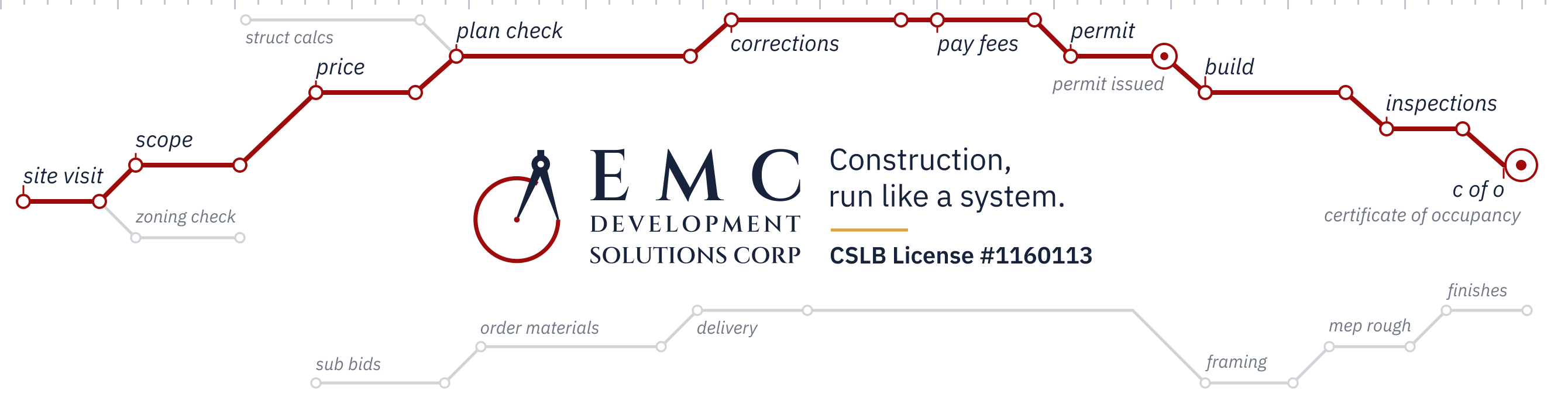
EMC Development Solutions Corp is a building contractor. Once the plans are approved, we can contract to build an ADU. Work starts only after the permit is issued. This is how we work. We walk the project with you and tell you plainly what the work involves and what could go wrong. The scope comes in writing, with the exclusions and assumptions, before any number appears. Every job is priced in a written proposal and a signed contract before work begins. When we build a project, the building inspections, through final, are part of the construction contract. Closeout is the final inspection and, where the building department issues one, the Certificate of Occupancy, with a complete record handed to you.
We do not prepare plans. They come from the owner's designer, architect or engineer. We will tell you on the first call whether the job is a fit.
EMC Development Solutions Corp is a private building contractor. This page is general information. It is not a publication of the City of Los Angeles, Los Angeles County or the State of California, and it is not legal advice. Law and department rules as of November 2026. Check with your building department before you rely on any of it.
Sources, read November 9, 2026: Government Code section 66328, from the Legislative Counsel's public text of the California codes; the HCD ADU Handbook (updated March 2026), glossary and the question "Do ADUs need a Certificate of Occupancy?"; LADBS Information Bulletin P/BC 2026-150, revised August 13, 2026; LADBS, About the construction process; Los Angeles County Public Works Building and Safety, Inspections.
Learn about our ADU builder work in Los Angeles County, or contact us about your ADU.
Planning an ADU? Call (909) 486-3818.
Call (909) 486-3818